
Famco Chimney Sweep in Baldwin Hills: A Homeowner’s Guide
If your chimney cap has a built-in damper and you can’t remember who installed it, there’s a reasonable chance it’s a FAMCO unit. And there’s an equally reasonable chance the last person who serviced it didn’t know how to adjust the tension spring correctly. Baldwin Hills homes, especially those built between the 1960s and 1990s, are full of FAMCO products that get cleaned around rather than serviced properly. This guide explains what you likely own and what correct maintenance actually looks like. If you’d rather not sort through it yourself, call (877) 752-4855 and we’ll take a look.
Key Takeaways
- FAMCO cap dampers and vent covers are common in Baldwin Hills but frequently misidentified during routine sweeps.
- A FAMCO damper that “looks closed” can still leak air if the tension spring and seating are off.
- Rotary brush cleaning requires removing or protecting specific FAMCO components first to avoid linkage damage.
- Coastal moisture and eucalyptus debris create predictable failure modes on FAMCO hardware in this area.
- Many FAMCO parts are still available through HVAC supply channels, making repair viable over full replacement.
What FAMCO Products Are Actually in Baldwin Hills Homes?
FAMCO is a manufacturer of ventilation products, and their residential chimney components end up in a lot of Southern California houses without homeowners ever knowing the name. The most common FAMCO product we see in Baldwin Hills is the cap-damper combination unit: a chimney cap with an integrated damper plate operated by a cable or rod that runs down the flue to a handle mounted on the fireplace wall. The second most common is the FAMCO vent cover, often used on multi-flue chimneys where one flue serves a fireplace and another serves a furnace or water heater.
Here’s a quick visual identification guide for what you might have:
- Cap-damper combo: A metal cap assembly at the top of the flue with a visible pivot pin and a cable attachment point on the underside. If you see a wire or small chain running down the inside of your flue, this is almost certainly what you have.
- Galvanized vs. stainless variants: Galvanized units show dull gray with eventual white oxidation spotting. Stainless stays brighter and resists rust but costs more. Baldwin Hills’ marine layer tends to put galvanized units on a shorter lifespan than the manufacturer’s general ratings suggest.
- Multi-flue vent covers: Rectangular metal covers spanning two or more flue openings, typically with a screen mesh section and a solid rain hood. These protect unused flues while allowing the active one to vent.
If you can’t tell what you have, we’re happy to identify it as part of a standard Chimney Sweep in Baldwin Hills visit. Correct identification matters because the service procedure changes depending on what’s up there.
The Tension Spring Problem: Why “Closed” Isn’t Always Closed
The most common FAMCO issue we encounter during sweeps in Baldwin Hills is a damper that appears closed but isn’t sealing. FAMCO cap dampers rely on a tension spring at the pivot point to keep the damper plate pressed firmly against its seat when the cable is released. Over time, that spring loses tension. The plate sits slightly open, or it closes unevenly with a gap on one side.
Here’s what correct seating looks like versus a problem unit:
- Correct seating: When you release the cable, the damper plate drops with a soft but definitive thud. From inside the fireplace, looking up, you should see an even gap of no more than an eighth of an inch around the entire circumference. The plate should sit flush against the cap base.
- Problem seating: The plate hangs at a slight angle, leaving a visible crescent gap on one side. Or it closes fully but lifts easily with one finger from below, meaning the spring isn’t holding tension. Or you hear rattling during wind because the plate is moving freely on its pivot.
Adjusting a FAMCO tension spring isn’t complicated, but it does require access to the cap, which means ladder work or roof access on most Baldwin Hills two-story homes. We don’t recommend homeowners climb onto tile roofs to do this themselves. The adjustment procedure involves setting spring tension so the plate seats firmly but not so tight that the cable becomes difficult to pull. If the spring is rusted or snapped, replacement is the only real fix.
What a Proper FAMCO-Aware Sweep Looks Like
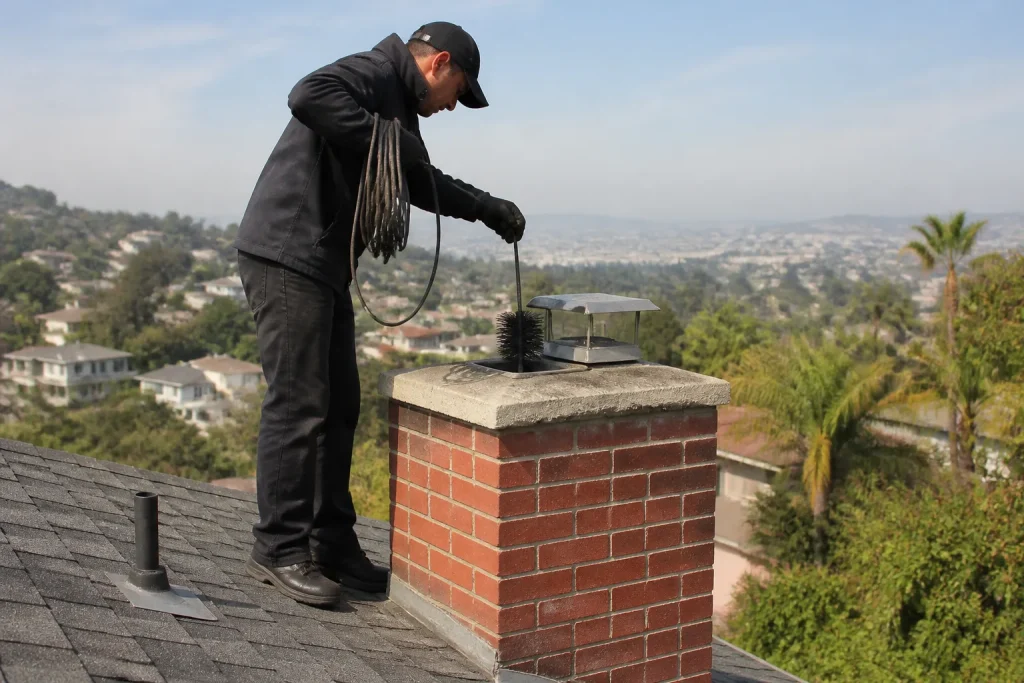
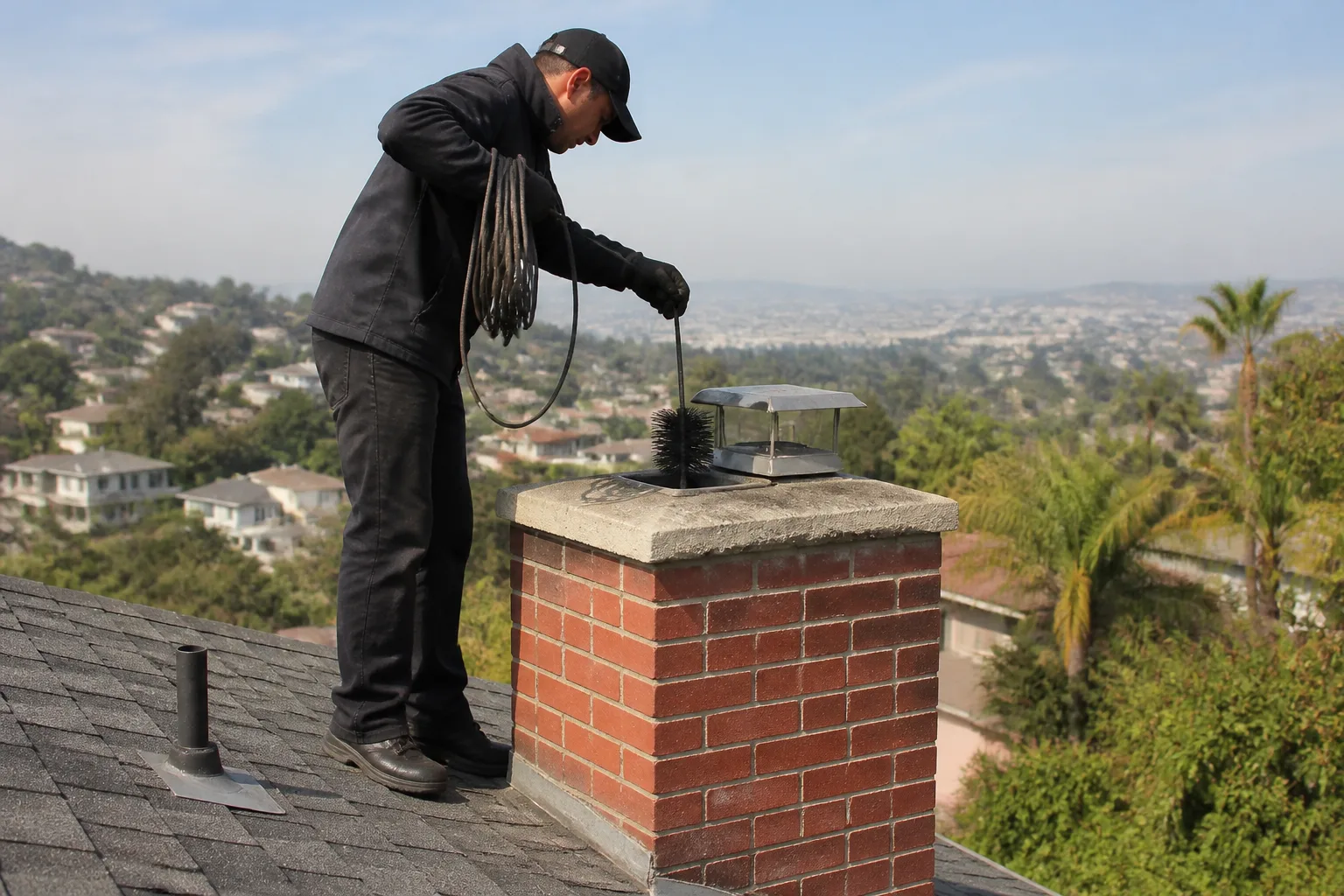
This is where the difference between a generic chimney sweep and one familiar with FAMCO hardware becomes obvious. Standard procedure for rotary brush cleaning involves running a spinning brush head down the flue from the top. On a FAMCO cap-damper installation, the cable and linkage run down the center of the flue. A brush that catches that cable can bend the linkage, snap the cable, or pull the damper plate off its pivot.
Here’s our process when FAMCO hardware is present during a sweep in Baldwin Hills:
- Remove the cap assembly from the top of the flue, detaching the cable at the crimp or clamp point.
- Set the cap, damper plate, and linkage aside in a protected location, not on the roof tile where it can slide.
- Sweep the flue with the rotary brush without any obstruction in the flue path.
- Inspect the pivot pin, spring, and cable for wear before reinstalling.
- Reinstall the cap, reattach the cable, and test the full open-close cycle from the handle inside the house.
We pulled a FAMCO cap off a house over near Kenneth Hahn Park last month where the cable had been wrapped around the brush shaft of a previous company’s sweep. The homeowner had been told the damper “needed replacement” when all it needed was a straightened cable and a spring adjustment. That’s the kind of thing you only catch if you know what you’re looking at.
Coastal Air and Eucalyptus: Baldwin Hills Failure Patterns
Baldwin Hills sits close enough to the coast that the marine layer rolls in most mornings, even during summer. That moisture interacts with FAMCO hardware in predictable ways. The pivot pin on the damper plate is the first failure point. It corrodes, the plate begins to bind mid-travel, and eventually it seizes or snaps. The silicone seal at the cap base degrades faster here than in inland areas, and once that seal goes, water seeps under the cap and runs down the outside of the flue liner.
Then there’s the eucalyptus. Baldwin Hills has mature eucalyptus throughout the neighborhood, from the slopes near the scenic overlook down toward the more residential streets off La Brea. Eucalyptus leaves are small, oily, and wind-carried. They clog FAMCO cap screens faster than other local debris. A screen that’s 60 percent blocked will restrict draft enough that smoke rolls back into the living room on a cold evening. We see this repeatedly during fall and winter sweeps here.
Regular inspection catches these issues before they become structural problems. If you notice rust stains on the cap, water streaks inside the firebox, or a damper handle that’s harder to pull than it used to be, those are signals worth investigating.
Repair or Replace? Making the Right Call
FAMCO products are still manufactured and distributed through HVAC supply channels, so a surprising number of components can be sourced without replacing the entire assembly. The decision tree we use when evaluating a FAMCO unit in Baldwin Hills goes like this:
- Adjustment only: The spring has lost tension but is intact, the cable moves freely, and the pivot pin is clean. Five minutes of spring tensioning resolves it. No parts needed.
- Replacement part: The spring is snapped or too weak to hold tension, the cable is frayed or kinked, or the pivot pin has corroded. These are individual parts, available through supply channels, and replacement costs a fraction of a full unit.
- Full replacement: The cap body itself has rusted through, the damper plate has warped from heat or corrosion, or the unit is a galvanized model that’s reached the end of its practical life. In these cases, we often recommend upgrading to a stainless model.
- Compatible alternatives: If an original FAMCO part is discontinued for a specific older model, compatible alternatives exist from companies like Copperfield and Olympia Chimney. These aren’t universal swaps; they need to match the flue diameter and the existing cable setup.
The key point: a FAMCO unit that’s acting up usually doesn’t need a full replacement. But you’ll only know for sure if someone actually inspects the hardware instead of defaulting to a sale.
For homeowners whose flue liner shows damage during a FAMCO service, the conversation shifts. We stock and install HeatShield and DuraFlex liner systems, which means a deteriorating flue can often be restored without tearing out the chimney. That’s a different level of repair than a sweep-only company can offer. Details are on our Chimney Repair in Baldwin Hills page.
Why Dryer Vents Belong in This Conversation
It might seem unrelated, but homes in Baldwin Hills with FAMCO chimney hardware often have another ventilation problem sitting in the laundry room. Dryer vents clog with lint, and lint is the leading cause of residential appliance fires in the U.S. The same coastal moisture that corrodes chimney caps also causes dryer lint to clump and adhere to vent walls, making blockages worse here than in drier climates.
We clean Dryer Vent Cleaning in Baldwin Hills as a standalone service because fire safety isn’t just a fireplace issue. If your chimney cap needs adjusting and your dryer hasn’t been vented in years, one visit can handle both. That’s the practical appeal of working with a company that covers both systems.
The Bottom Line
FAMCO chimney products are well-built and widely installed in Baldwin Hills, but they’re frequently misidentified and under-serviced by sweep companies that don’t know the product line. A damper that doesn’t seat correctly leaks conditioned air and moisture into your chimney year-round. A cap screen clogged with eucalyptus chokes your draft. And a rotary brush run past a FAMCO cable linkage can cause real damage that gets blamed on the hardware rather than the procedure.
The good news is that most FAMCO issues are repairable, parts are available, and proper service isn’t complicated if you know the hardware. If you’re in Baldwin Hills and want someone who does, Chimney Sweep Baldwin Hills offers free estimates. Call (877) 752-4855 and we’ll tell you exactly what’s up there and what it needs.
Frequently Asked Questions
Look for a cable or small chain running down the inside of your flue to a handle on the fireplace wall. That’s the signature of a FAMCO cap-damper combo. The cap itself will have a visible pivot pin and a metal plate that opens and closes when you work the handle. If you’re not sure, a chimney service familiar with the product line can identify it during a standard visit.
Yes, in most cases. If the spring is intact but has lost tension, it can be re-tensioned at the pivot point. If the spring has snapped or the cable is frayed or kinked, those parts are individually replaceable through HVAC supply channels. Full replacement is only necessary when the cap body or damper plate has rusted through or warped. Call (877) 752-4855 for an exact assessment; estimates are free.
Eucalyptus trees throughout Baldwin Hills drop small, wind-carried leaves that collect on cap screens faster than most other local debris. Combined with the morning marine layer that makes debris stick, screens can clog within a single season. Regular sweeping and occasional screen cleaning during the fall keep draft flowing properly.
If your galvanized cap shows rust staining, corroded pivot hardware, or you’re already replacing other components, upgrading to stainless makes sense for the Baldwin Hills climate. Stainless resists the coastal moisture that shortens galvanized lifespans here. If the cap is still structurally sound, though, a spring adjustment and new seal are usually enough to keep it working. Call (877) 752-4855 and we’ll give you an honest read on what yours needs.
Written by the team at Chimney Sweep Baldwin Hills, serving Baldwin Hills since 2015.
Need Chimney Cleaning Help?
Call Chimney Sweep Baldwin Hills - licensed & insured, with free written estimates in Baldwin Hills.
(877) 752-4855